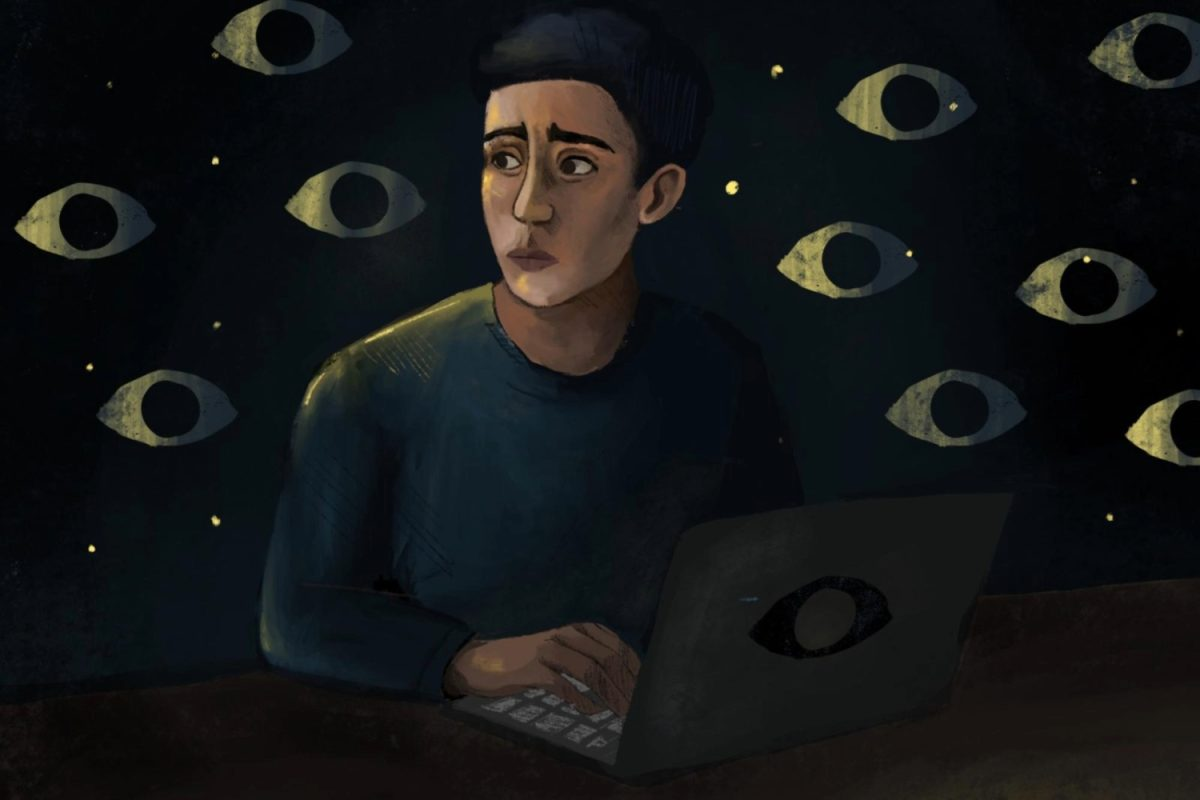

Am I being filmed? If I was being filmed, would I know?
These are questions I sometimes catch myself wondering. Normally I quickly brush them off or do one last double take toward the imaginary camera behind me, but recently I started thinking about it a little more deeply. It’s a ridiculous thought to even cross my mind, and the fact that it happens so frequently, and to so many people, indicates something deeper than just a small fear.
Technology has made this instinct even more tangible. Every phone, smart device, and app has the potential to watch, record, or interpret parts of our lives, often without our knowledge. This is why the 1999 film, “The Truman Show,” remains haunting more than two decades later.
This fear lies behind every stoplight that turns red the second you pull up to it, every advertisement that pops up on your phone five minutes after you talked to your friend about it, and every person you noticed for the first time a week ago who now seems to be everywhere. Though all of these experiences are relatively universal and have simple explanations, sometimes I can’t help but look around and wonder if someone in a dome in the sky is messing with me.
This fear lies in the very innate instinct of being watched, being perceived, and living in a different reality than the one we know. Most people have experienced this feeling and fear of being watched before, but why? Why do we even humor such a ridiculous and narcissistic idea?
This goes back to early times, as the fear of being watched is one of the oldest human instincts. For our ancestors, it meant danger. An enemy lurking in the shadows or a predator hiding just beyond our eyesight — to be watched was to be vulnerable.
However, our modern adaptation of this fear is in new technology and the possibilities it creates. Before, the idea of your life being recorded and moderated seemed like science fiction, but nowadays, is it really? New technology is constantly reshaping how we are seen, recorded, and interpreted. Every camera, app, and smart device increases the chances of parts of our lives being captured.
This isn’t paranoia. This is a fact.
Do you know how much of your data is being sent worldwide? How many individuals have information that you will never know? The answer to this question is a resounding no. You do not. This fact no longer makes me fear being watched by some fantastical delusion. It is simply reality, and though our lives most likely aren’t being watched by viewers worldwide, it’s not completely inconceivable how we might jump to that conclusion.
Our fear is also fueled by newness.
Technology moves faster than our instincts can adapt. Think about if your mother was told thirty years ago that soon we would be able to record every single moment of our lives and essentially share it with the world in a matter of seconds. She would probably call you insane.
We aren’t particularly worried just because of the idea of being watched, but more because we can’t fully understand how. Algorithms interpret our behavior in ways we cannot see, surveillance tools track us in ways we cannot anticipate, and other people’s cameras take pictures of us that are shown to people we will never see.
With every innovation, the line between reality and observation blurs. It’s a modern twist on the ancient fear of being watched and has grown into the fear of being analyzed, recorded, and misunderstood by systems we don’t yet grasp.
Unfortunately, there is no solution to this. There is no way to escape the growing role of technology and surveillance in our lives. “The Truman Show” reminds us why this instinct exists. Being observed without knowing how or why taps into something primal.
Today, with cameras, algorithms, and smart devices everywhere, that fear is somewhat grounded in reality. And yet, even knowing it is justified, it doesn’t have to dominate how we live.
Every generation experiences a fear of the unknown, and this manifests in different ways regarding the political, social and technological environment of time. At the end of the day, the fear of being perceived and the uncertainty of the unknown is a part of life. However, it doesn’t mean we have to live in fear. Instead, we can acknowledge it, stay aware, and remain curious about what technology makes possible instead of dwelling on the facts of life we won’t be able to control .
Though I can say with probably 99.9% certainty that there is no camera on me right now and that writing this article isn’t some terribly ironic joke, it doesn’t make this fear any less real or its reasoning any less sound. Fear of being perceived and understanding that fear is key to understanding the human psyche and the evolving role of perception and technology in the years ahead.